
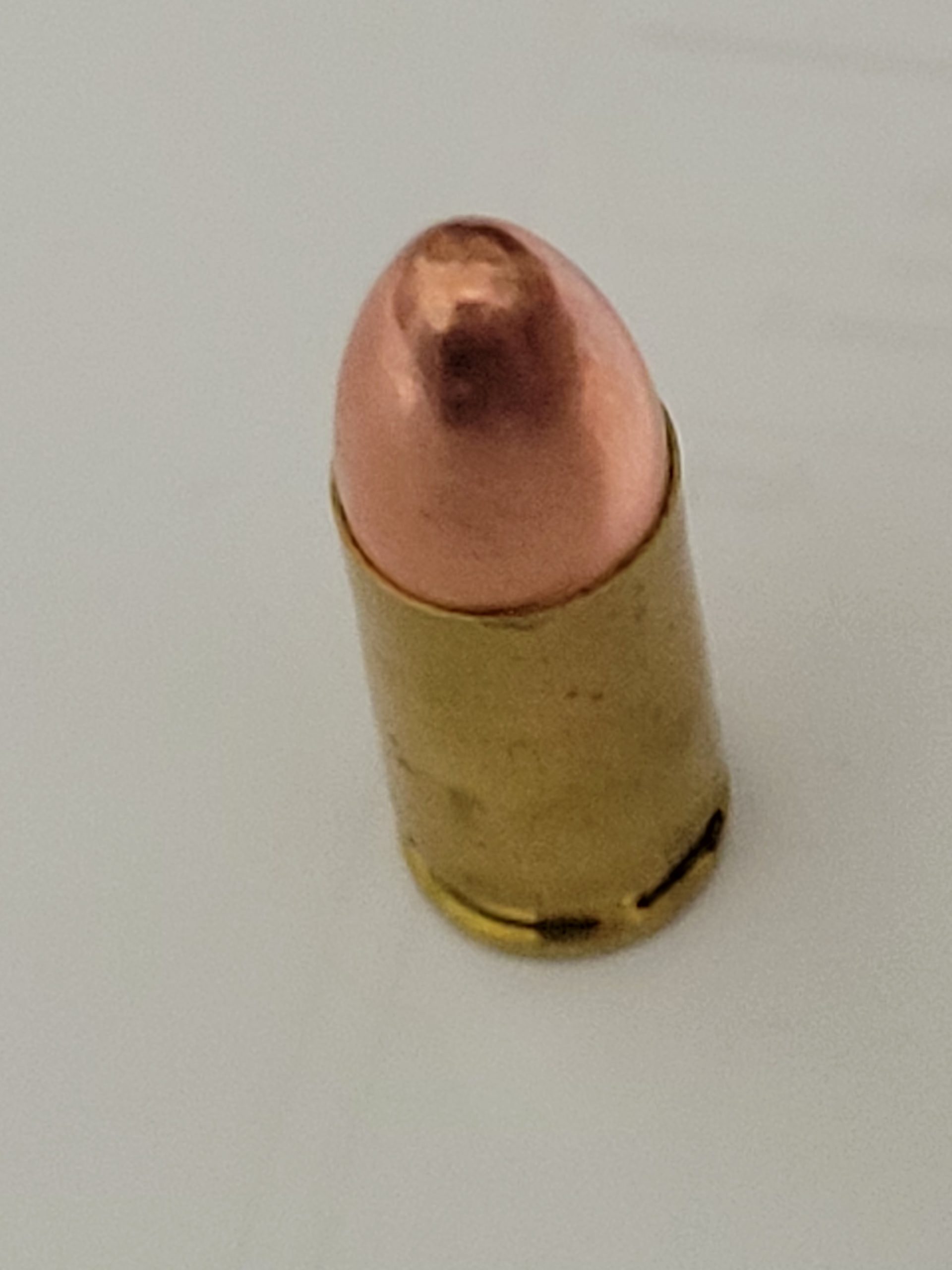
Many people who are new to shooting may not realize that a “bullet,” more properly called a “cartridge,” is actually made of four parts. In brief, a cartridge has a case (or shell), a primer (or primer assembly), powder, and the projectile. I’ll be discussing each of these in turn. This is a brief discussion. I’m not an expert and there are many layers deeper that can be gone on this topic. I will link a couple of references.
Casing
Let’s start with the casing. It’s sometimes called “the brass” because that is what it is typically made from. This is what gets ejected from a semi-automatic weapon. It usually has the caliber marked on the bottom. Cartridges can be center-fire or rim-fire. The majority are center-fire. If you look at a casing after it has been ejected, you will see a small dimple on the bottom in the middle. That is from the firing pin striking the casing. On a rim-fire gun, the cartridge will be hit closer to the edge of the casing’s rim.
Primer
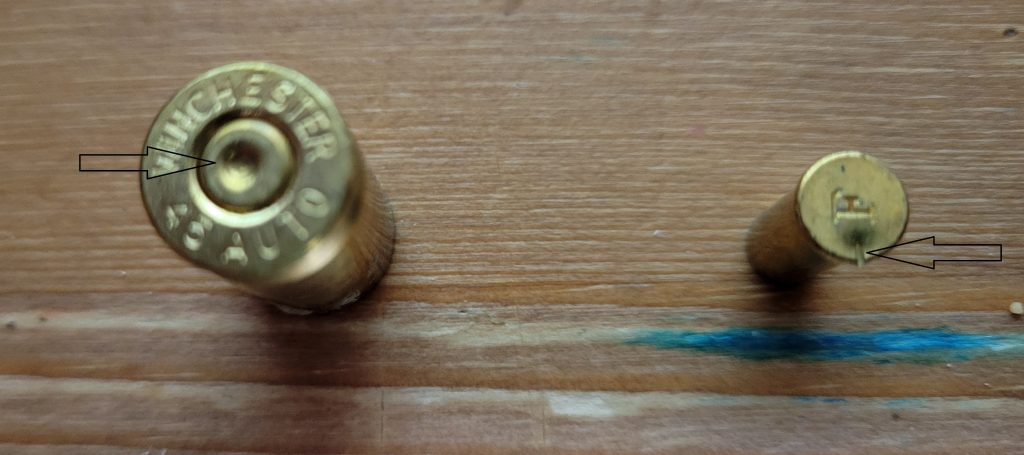
The primer sits in the bottom of the casing. It contains a small amount of powder and an anvil. When the hammer hits the cartridge, the anvil hits the powder and causes a small spark. The spark goes through a flash hole and ignites the gun powder. For rim-fire cartridges, the primer is in the bottom rim of the casing, rather than in a primer assembly in the bottom center.
Gunpowder
The gunpowder is the propellant that builds pressure when it is lit by the spark. The propellant expands, creating gases that push out on the sides of the cartridge and on the projectile. The amount of powder affects the speed of the bullet.
Different calibers of cartridge contain different amounts of gunpowder. A single caliber may have more than one possible. You may see +P on a box for a cartridge with some extra power. For those who reload their own ammo, one of the things they do is adjust the amount of gunpowder to see how it affects speed. This is still done within some tight tolerances in order for the cartridge to work correctly.
Projectile
The projectile gets pushed down the barrel and out of the firearm. The barrel has rifling which is a twist along the inside of the barrel. The rifling causes the projectile to turn. This affects the stability of the projectile once it leaves the barrel. If you see a fireball, it is pressure that did not take place inside the barrel. It did not affect the speed of the projectile. In a longer barrel, that fire would have been enclosed in the barrel itself. In that case, it would affect the speed by pushing the projectile with more oomph.
I want to mention that shotguns use different types of ammo. Bird-shot, buck-shot, and slugs have multiple projectiles in a larger casing. I’m not getting any further into shotgun shells as I do not have any experience with these.
There are also multiple types of projectiles. A projectile’s shape helps to determine its penetration and whether it expands. The most common shape/type is a full metal jacket, with a rounded conical tip. Another type, typically called a hollow point or defense round, has a shape more like a group of petals. Those petals open outward, expanding and causing more damage. Another type is the soft-point, which is a balance between penetration and expansion. It is usually used for hunting.
Like the gunpowder in a cartridge, the weight of a bullet is also measured in grains. For example, this box shows a 9 mm cartridge with 115 grains. Other 9 mm cartridges may weigh 147 grains. Some people load their own cartridges and may use different quantities. To better understand grains, check out Why Grains?

Conclusion
This has been a brief overview of the parts of a cartridge and how they affect the process of getting a projectile down range. There are good videos that go into more detail. If you’re interested, check out Basic Parts and Functions of a Firearm Cartridge for more in-depth information. For information on other shooting-related terms, see Shooting Terms.
Leave a Reply